

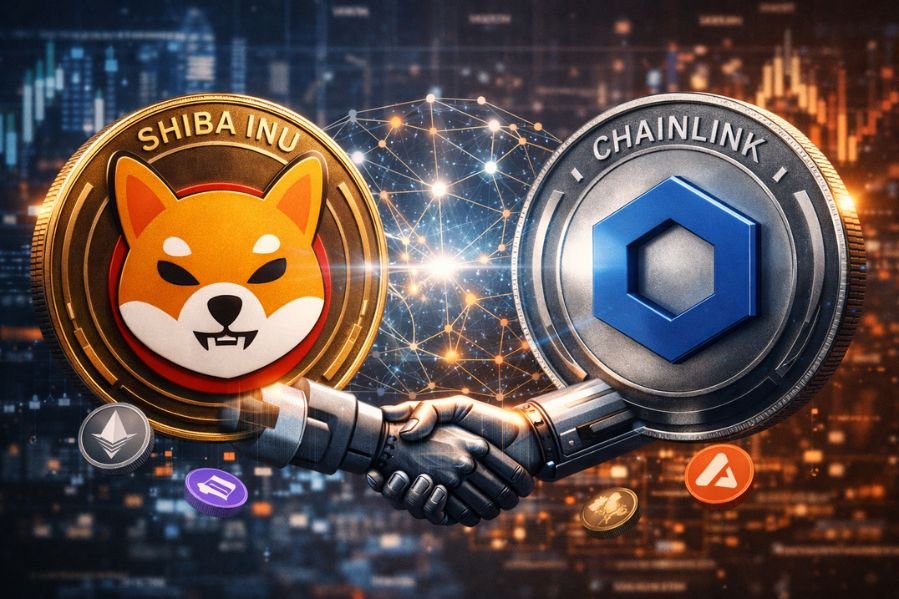

The Shiba Inu chainlink partnership has become one of the most important developments in the broader Shiba Inu ecosystem because it signals a serious attempt to move SHIB beyond its meme-coin identity and toward a more practical, infrastructure-driven role in decentralised finance. The collaboration centres on Chainlink’s Cross-Chain Interoperability Protocol (CCIP) and the adoption of the Cross-Chain Token (CCT) standard, a framework that enables tokens to move more securely and efficiently across blockchain networks. Publicly available Chainlink ecosystem materials list the Shib ecosystem as live with CCIP support and note a December 19, 2024 announcement tied to cross-chain functionality, while Chainlink’s own CCIP materials later referenced Shiba Inu among projects expanding CCIP-powered tokens further into the multichain environment.
Why the Shiba Inu Chainlink Partnership Matters
For years, Shiba Inu was viewed mainly through the lens of internet culture, retail enthusiasm, and speculative momentum. That attention helped SHIB become globally recognised, but visibility alone does not create durable blockchain utility. What changes the conversation is infrastructure. The Shiba Inu chainlink partnership matters because it shifts attention from branding to execution. Instead of being confined to a single-chain narrative, SHIB, along with ecosystem assets such as BONE and LEASH, can be positioned for a broader multichain future. Chainlink ecosystem information states that the Shib ecosystem’s CCIP integration supports activity across 12 blockchains, and the stated goal is interoperability rather than isolation.
The Role of Chainlink CCIP in the SHIB Ecosystem
At the centre of the Shiba Inu chainlink partnership is CCIP, which is designed to help blockchains communicate more reliably. In the past, cross-chain expansion often depended on fragmented bridge models that introduced extra operational and security concerns. Chainlink positioned CCIP as a more standardised interoperability layer, and its own documentation describes CCTs as cross-chain native tokens secured by CCIP with developer control, self-serve deployment, and zero-slippage transfers. That matters for Shiba Inu because the ecosystem’s next phase depends less on hype and more on whether its tokens can move in a way that developers, traders, and DeFi users actually trust. Rather than treating each chain as a disconnected island, CCIP aims to allow projects like Shiba Inu to expand their footprint while maintaining a more coherent token framework.
Multichain Expansion Gives SHIB a Bigger Playing Field
One of the clearest benefits of the Shiba Inu chainlink partnership is the expansion of SHIB-related assets into a wider multichain environment. Chainlink ecosystem materials associate the Shib ecosystem with support across networks, including Ethereum, BNB Chain, Arbitrum, Optimism, Base, Polygon, Scroll, Linea, Gnosis Chain, Mantle, and Avalanche. The practical meaning of that expansion is simple: users do not have to see SHIB as an asset limited by one ecosystem’s costs, speed, or congestion. A multichain token can reach new user bases, attract fresh liquidity pools, and enable more application-level use cases. This matters especially in a market where blockchain activity is increasingly distributed across Layer 2s and alternative execution environments. If SHIB is available where users already are, its chances of deeper integration rise considerably.
Cross-Chain Token Standard Changes the Quality of Expansion
Not all multichain growth is equal. A token can appear on multiple chains and still suffer from fragmented liquidity, inconsistent implementations, or trust concerns around bridge wrappers. That is why the CCT standard is such a major piece of the Shiba Inu chainlink partnership. Chainlink describes the standard as a way for projects to make tokens cross-chain transferable via CCIP while keeping stronger developer ownership and more direct control over deployment. Shiba Inu’s SHIB, BONE, and LEASH are listed among the token sets that adopted the CCT standard. This is important because it changes the narrative from “SHIB is being copied around chains” to “SHIB is being structured as a deliberate multichain asset.” That distinction may sound technical, but it shapes how seriously exchanges, DeFi builders, and more advanced users take the ecosystem.
What This Means for DeFi Utility
The biggest long-term opportunity in the Shiba Inu chainlink partnership may be DeFi. Utility in crypto is rarely about abstract promises. It becomes real when an asset can be used as collateral, deposited into lending markets, moved into liquidity systems, or embedded into applications that users access every day. Folks Finance publicly describes its xChain app as a cross-chain lending and borrowing platform built on a hub-and-spoke architecture, where users can deposit on one chain and borrow on another. Its documentation emphasises cross-chain collateralization and a unified protocol state, both of which benefit from reliable interoperability messaging. Separate reporting in 2025 tied SHIB’s entry into cross-chain lending markets to this broader CCIP-enabled direction, although that later DeFi rollout should be understood as part of the evolving ecosystem rather than the entirety of the original December 2024 announcement.
A More Serious Image for the Shiba Inu Brand
Another important dimension of the Shiba Inu chainlink partnership is perception. Branding alone does not sustain value, but infrastructure partnerships can alter how a project is viewed by the market. Chainlink is widely recognised in both DeFi and tokenisation discussions for its work on data feeds, cross-chain infrastructure, and collaborations referenced in institutional and enterprise contexts. While it would be an exaggeration to say the partnership alone makes Shiba Inu an institutional asset, it is fair to say that integration with Chainlink moves the ecosystem closer to professional-grade tooling than meme branding ever could on its own. In crypto, credibility often grows when a project stops talking only about community enthusiasm and starts adopting the same technical rails used by more utility-focused platforms. That is one reason this partnership attracted attention well beyond the Shib community itself.
Liquidity, Access, and the Push Against Fragmentation
A major weakness of many multichain strategies is liquidity fragmentation. When assets are spread across numerous networks without a strong interoperability framework, users can end up with thinner markets, inconsistent pricing, and trapped capital. The appeal of the Shiba Inu chainlink partnership is that it supports a more unified vision. Chainlink’s own CCIP discussions emphasise reduced fragmentation and stronger composability across applications, particularly in financial services such as lending and borrowing. Folks Finance also describes a model in which protocol state is maintained on a hub chain, ensuring consistency across spoke chains. Taken together, these ideas point to a future in which SHIB’s liquidity is not merely scattered across ecosystems but coordinated to make access easier and capital more productive. That does not eliminate all market risk, but it does create a stronger structural foundation than isolated chain-by-chain deployments.
Can This Partnership Actually Change SHIB’s Long-Term Story?
That is the core question. The Shiba inu Chainlink partnership does not automatically guarantee price appreciation, mass adoption, or an overnight identity shift. However, it does give the Shiba Inu ecosystem something it critically needed: a more believable path toward functionality. Public Chainlink materials connect the Shib ecosystem to CCIP and later to further expansion into Solana through CCIP v1.6, showing that this was not a one-day headline but part of a broader multichain roadmap. If the ecosystem continues pairing interoperability with real use cases such as lending, collateral deployment, and deeper on-chain integrations, then SHIB’s role could gradually become more utility-oriented. The real test will not be whether the announcement sounded impressive, but whether builders, platforms, and users continue to use the infrastructure the partnership introduced.
Risks and Realistic Expectations
It is still important to stay grounded. Even strong infrastructure partnerships cannot eliminate the volatility of crypto markets. SHIB remains a highly recognised speculative asset, and market psychology will continue to influence it. There is also a difference between having the technical ability to move across chains and achieving sustained demand across those chains. Adoption must be earned through applications, incentives, liquidity depth, and user trust. Some public commentary around the partnership has also mixed confirmed details with more aggressive claims, particularly around exact transfer times, burn mechanics, or immediate DeFi outcomes. The more reliable takeaway is that the partnership clearly established CCIP-based interoperability and CCT adoption, while some broader impacts should be treated as evolving possibilities rather than guaranteed results.
Conclusion
The Shiba Inu Chainlink partnership represents a meaningful strategic step in Shiba Inu’s evolution from a meme-driven token story toward a more utility-focused ecosystem. By adopting Chainlink CCIP and the Cross-Chain Token standard, the Shib ecosystem gained a framework for broader blockchain access, more coherent multichain token movement, and stronger relevance in modern DeFi discussions. That does not mean SHIB has instantly become a purely utility asset, but it does mean the project now has more credible infrastructure behind its long-term ambitions. In a market where interoperability, composability, and capital efficiency increasingly matter, this partnership may prove to be one of the most important moves in SHIB’s effort to become more than a cultural phenomenon.
Disclaimer
This article is for just informational purposes only and should not be considered financial, investment, or trading advice. Cryptocurrency markets are volatile, and projects, protocols, and token utility can change over time. Readers should do their own research, verify official announcements, and assess their own risk tolerance before making any financial decisions.
For More Information cryptobignews.com
