

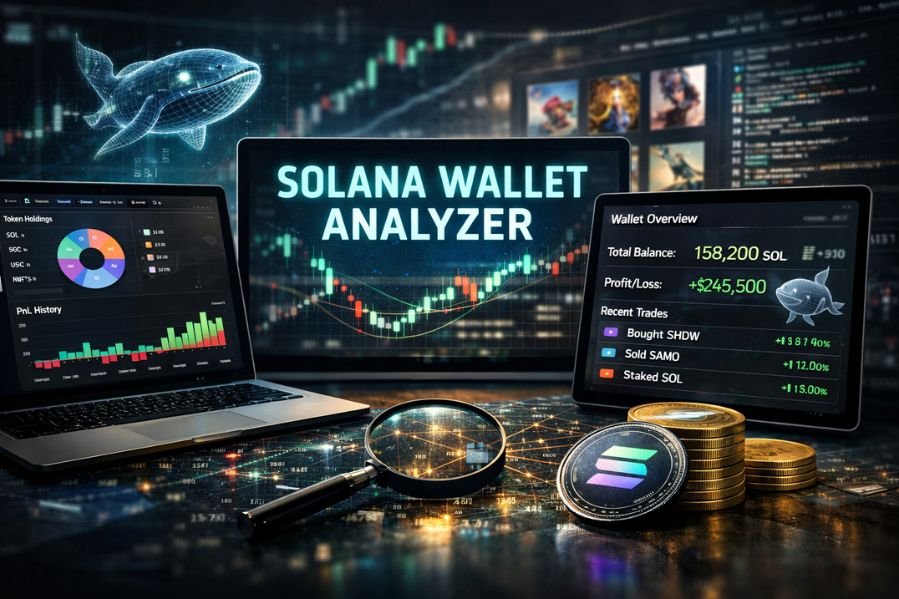

The rise of Solana as one of the fastest and most active blockchains has driven strong demand for greater on-chain visibility. Traders, investors, researchers, and even curious newcomers often want to understand what is happening inside a wallet before making a decision. This is where a Solana wallet analyzer becomes incredibly useful. Instead of looking at raw blockchain data and trying to make sense of endless transaction hashes, users can rely on a wallet analyzer to present complex information in a clearer and more practical format. A good analyzer can help reveal token balances, transaction history, swaps, staking behaviour, NFT holdings, and, in some cases, even estimated profit and loss, wallet patterns, and interactions with decentralised applications. As Solana continues to grow in decentralised finance, memecoins, NFTs, and smart money activity, wallet analysis tools are becoming more than a convenience. They are turning into an essential part of informed decision-making for anyone who wants to better understand public wallet behaviour on the network.
What Is a Solana Wallet Analyzer?
A Solana wallet analyzer is a tool designed to inspect and interpret public Solana wallet addresses. Since blockchain data is public by nature, anyone can look up a wallet address, but the raw data itself is often difficult to read. Transactions may involve multiple token transfers, swaps across decentralised exchanges, staking operations, liquidity positions, and smart contract interactions that are not obvious at first glance. A wallet analyzer organizes this information into a readable dashboard so users can quickly understand what a wallet is doing and how it has behaved over time. Some tools focus on transparency and simple transaction viewing, while others are built for advanced users who want detailed behavioural analysis, historical performance, and wallet clustering. In practical terms, these tools can help answer questions such as which tokens a wallet currently holds, what it bought or sold recently, how frequently it trades, which protocols it uses, whether it has participated in NFT activity, and whether it appears to belong to a large whale or an experienced trader. This combination of visibility and interpretation is what makes wallet analyzers so powerful in the Solana ecosystem.
Why Wallet Analysis Matters on Solana
Understanding wallet activity on Solana matters because the network moves quickly and information often spreads through wallet behaviour before it becomes widely discussed in public channels. In a fast-paced environment where narratives shift within hours, tracking the actions of active wallets can provide useful insight into emerging trends. A wallet analyzer can show if a particular address has started accumulating a token, rotating into a specific sector, or exiting a position after a rally. For traders, this can be valuable for spotting momentum or identifying caution signals. For long-term investors, it can help separate genuine conviction from temporary hype. For researchers and analysts, wallet activity can reveal how capital flows through protocols, which decentralised applications are gaining traction, and how users are interacting with the broader Solana ecosystem. The value of a Solana wallet analyzer is not just in displaying data but in reducing the time it takes to turn blockchain records into meaningful observations. That speed and clarity can be the difference between informed action and blind guessing.
Core Features of a Good Solana Wallet Analyzer
Not every wallet analysis platform offers the same depth, so it is important to know which features actually matter. One of the most basic and essential features is a clean display of token balances. Users should be able to see what assets a wallet currently holds, including both major tokens and lesser-known SPL tokens. Another important feature is transaction history, which gives context to how the wallet built or reduced those positions over time. This includes transfers, swaps, staking actions, liquidity provision, and NFT-related operations. A stronger analyzer will go beyond raw history and provide some form of PnL tracking, helping users estimate realised and unrealised gains across trades. While these estimates are not always perfect, they can still offer useful directional insight. High-quality tools may also include wallet labels for identifying exchange wallets, treasury addresses, smart money participants, and contract-related wallets. Some analyzers offer whale tracking, real-time activity monitoring, and alerts for significant moves. Others include NFT support, DeFi exposure, token holding duration, and interaction summaries with protocols or dApps. Together, these features help convert blockchain noise into a more coherent story about what a wallet is actually doing.
How Traders and Researchers Use These Tools
A Solana wallet analyzer can serve different purposes depending on who is using it. For traders, it is often a way to study successful wallets and learn from their habits. A trader might track a wallet known for early entries into trending tokens, then watch for changes in its portfolio, timing, and rotation strategy. This can help build a market thesis, though it should never replace independent research. For researchers, analyzers can provide a broad view of ecosystem participation. They may examine how wallets engage with lending platforms, staking services, perpetual trading apps, or NFT marketplaces to evaluate where activity is growing. Builders and project teams can also use wallet analysis to understand user behaviour, measure engagement, or observe how capital is moving around their protocol after a launch or campaign. Even regular holders can benefit from analyzers by using them to review their own public wallet history, understand transaction patterns, and keep a better record of their asset movements. In that sense, wallet analyzers are not only for elite traders or deep on-chain researchers. They are increasingly useful for anyone seeking better context on public blockchain activity.
Solana Wallet Analyzer and Smart Money Tracking
One of the biggest reasons people search for a Solana wallet analyzer is to follow so-called smart money. This phrase generally refers to wallets believed to be operated by successful traders, early adopters, funds, insiders, or experienced market participants. Smart money tracking has become popular because many users hope to identify patterns from wallets that consistently move before the crowd. A wallet analyzer can make this process easier by showing historical trades, token rotation, average holding periods, and previous interaction with successful projects. Some advanced tools also add machine-driven labels or wallet scores to help users spot higher-signal addresses. However, smart money tracking should be approached with caution. Even if a wallet has a strong record, copying its activity without understanding context can be risky. The wallet owner may be hedging elsewhere, managing a larger portfolio, or operating with information and timing advantages that are not visible from the chain alone. A good analyzer helps reveal behaviour, but it does not guarantee that following that behaviour will lead to the same results. The real advantage lies in using the data as an input for better reasoning, not as a shortcut to easy profits.
What to Look for When Choosing the Right Tool For Solana wallet
Choosing the right Solana wallet analyzer depends on your needs. If your goal is simple inspection, you may prefer a tool with a clean interface and strong transparency features. If you are focused on trading intelligence, you might want an analyzer that includes wallet scoring, real-time alerts, and estimated PnL metrics. For portfolio tracking, ease of use and accurate asset categorisation may matter more than advanced data layers. It is also worth paying attention to how quickly the platform updates wallet activity. On Solana, speed matters, and delayed data can render insights less useful. Another factor is how well the analyzer handles NFTs, staking, and DeFi positions, because wallet activity on Solana often extends beyond simple token transfers. Some tools are stronger for manual research, while others are better for automated monitoring or performance analysis. Users should also consider whether the analyzer provides enough context around transactions rather than simply listing them. A wallet tool becomes more valuable when it helps interpret behaviour, not just display it. The best choice is usually the one that aligns with your purpose rather than the one with the longest feature list.
Common Limitations of Wallet Analyzers
Even the best Solana wallet analyzer has limitations, and it is important to understand them before relying too heavily on any single dashboard. Blockchain data is public, but interpretation is never perfect. Wallet ownership is often unknown, and the same person may control multiple addresses. Some transactions may appear profitable in isolation while actually serving a larger hedging or treasury strategy that is invisible from the public wallet alone. PnL calculations can also be approximate, especially when wallets receive transfers from outside sources, interact with multiple protocols, or hold illiquid tokens with unstable pricing data. In addition, labels such as whale, fund, or insider are often based on heuristics rather than confirmed identity. Another limitation is that transaction visibility does not equal full context. A wallet may buy a token for reasons not apparent from on-chain records, and timing alone does not prove insight or manipulation. That is why wallet analyzers are best used as research tools rather than prediction machines. They can significantly improve understanding, but they should be combined with broader market awareness, project analysis, and risk management.
Best Practices for Using a Solana Wallet Analyzer
To get the most value from a Solana wallet analyzer, users should adopt a thoughtful approach. Start by identifying the kind of wallet you want to study. It could be your own wallet, a whale wallet, an early trader, a project treasury, or a wallet linked to a protocol you are researching. Look beyond current balances. Historical behaviour often tells a more useful story than a snapshot. Pay attention to entry and exit timing, trade frequency, the diversity of holdings, and which applications the wallet interacts with most frequently. It is also helpful to compare multiple wallets rather than focusing on just one. Patterns that repeat across several active addresses are often more meaningful than a single isolated move. Avoid assuming that every large transaction is smart or that every profitable wallet will remain profitable. Use wallet analysis to gather signals, test ideas, and improve your understanding of market behaviour. The most effective users treat these tools as a way to sharpen judgment rather than outsource it.
Conclusion
A Solana wallet analyzer has become an essential tool for anyone who wants to better understand activity on the Solana blockchain. Whether the goal is tracking token balances, reviewing transaction history, monitoring NFT movements, estimating performance, or following smart money, a strong analyzer can make public blockchain data far easier to interpret. In an ecosystem as fast-moving and information-dense as Solana, clarity matters. Wallet analysis tools help users turn scattered transaction records into practical insight, making them useful for traders, investors, researchers, and everyday users alike. Still, the smartest way to use these platforms is with balance. They are powerful for discovery, comparison, and context, but they should support research rather than replace critical thinking. When used properly, a good wallet analyzer can become one of the most valuable tools in understanding how value, sentiment, and strategy move across the Solana network.
Disclaimer
It’s not financial advice and Investment, legal, or tax advice. A Solana wallet analyzer can help interpret public blockchain activity, but no tool can guarantee accuracy, profitability, or future market outcomes. Always conduct your own research, verify on-chain data independently, and consult a qualified professional before making financial or tax-related decisions.
For More Information cryptobignews.com
