

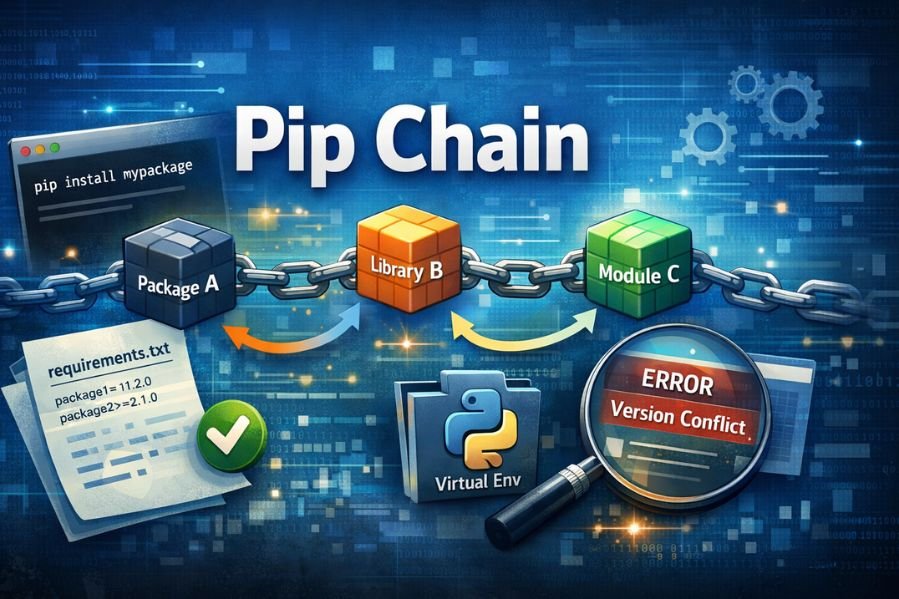

The term pip chain may seem technical, but it becomes clear when broken into practical parts. In most Python contexts, pip chain refers to the sequence of packages and subpackages installed when using pip. In short, installing one package may require others, which in turn may require even more, forming a chain of dependencies. Pip must detect, evaluate, and install these. Understanding the pip chain is important for developers, analysts, testers, and anyone maintaining Python environments. It clarifies why a single command can trigger many installations and why errors may appear even when the package name is correct.
What Pip Actually Does
To understand the pip chain, first understand pip’s purpose. Pip is the standard Python package installer and downloads libraries from repositories into your environment. Pip does more than fetch by name. It reads metadata, checks version requirements, finds dependencies, and installs a compatible set. Pip builds and evaluates a dependency graph behind the scenes. When users mention pip chain, they often mean the process where pip follows dependencies until the environment has everything the package needs.
The Meaning of Dependency Chain
A dependency chain is usually what people mean by ‘pip chain.’ If you install a web framework that depends on a utility, a config parser, and a networking tool, those may depend on others. Pip tracks these links in order. The sequence forms a dependency chain, with each package relying on the previous one. As your software stack grows, this chain becomes more crucial. Small applications have short chains; large ones may have hundreds. Understanding the pip chain helps developers see how components connect and where failures can occur.
Why Pip Chain Matters in Real Projects
Python users often notice pip chain only when issues arise. A package may fail to install, or a project may break after a library upgrade. These problems usually result from dependency relationships, not the main package. One package may require an old version of a library, while another needs a newer one. This tension forces Pip to find a compatible combination. If it cannot, installation errors or runtime issues can follow. Knowing how pip’s dependency resolution works helps you build clean environments, spot conflicts quickly, and avoid unstable packages. It also explains why a project may act differently across systems if dependencies are installed under different conditions.
How Pip Resolves the Chain
Pip’s installation process is smarter than many assume. Modern pip versions use dependency resolution logic to select compatible versions. Pip starts with your requested package, reads its dependencies, and checks further dependencies. If conflicts arise, pip may retry with other versions. This can be slow for complex stacks, but it creates a compatible environment. This is why pip chain matters: it ensures the supporting structure is valid. When the resolver succeeds, you get a working environment. If requirements conflict, pip makes this clear in its messages.
Common Problems Inside a Pip Chain
A pip chain can break or become hard to manage due to version conflicts—when two packages require incompatible versions of the same dependency. Stale package pinning (using outdated requirements.txt) also causes issues. Mixing system-wide and virtual environment packages makes tracking more difficult. Sometimes, an install succeeds, but a hidden dependency fails at runtime. These show the pip chain is practical, not abstract. It affects software stability, deployment, and development. Understanding the chain helps isolate real problems faster.
Pip Chain and Requirements Files
One effective way to manage a pip chain is with a requirements file. A requirements.txt lists package names and often specific versions so you can recreate the same environment. This is useful for teams, test pipelines, and deployments. Without a documented pip chain, developers may install the same main package but get different supporting libraries, leading to inconsistencies. Reproducibility in Python means controlling the pip chain. A good requirements file brings order and prevents unexpected drift. It also improves collaboration by providing a shared baseline for everyone.
Virtual Environments and Cleaner Dependency Control
A virtual environment is one of the best ways to manage a pipeline chain. Instead of installing packages globally, you isolate them per project. This prevents dependencies from interfering across projects and makes it easier to inspect, update, or rebuild without affecting your system. Skipping virtual environments leads to tangled dependencies. Clean environments help you see which packages support each purpose, making the chain manageable rather than chaotic. This habit is crucial for serious Python development.
Pip Chain in Package Auditing and Troubleshooting
Troubleshooting is easier when you think in terms of the pip chain rather than just the final installed package. Many issues result from deeper dependency relationships. If a project fails after an update, the cause may be a transitive dependency with breaking changes or dropped compatibility. Viewing installs as a chain helps you trace errors logically and ask better questions: which package introduced the dependency, which version changed, and what else relies on it? This mindset is key in debugging. Focus on the broader package ecosystem to find answers.
Another Meaning of Pip Chain: Chaining Libraries and Syntax
While ‘dependency management’ is the main meaning of ‘pip chain,’ some discussions use ‘chain’ to describe a style in which methods or operations link smoothly. Some Python packages support chaining, making code more readable and expressive. Functional libraries let you pass data through several chained transformations. Though this isn’t the main meaning, it appears when discussing pip-installed packages with chaining behaviour. Know this meaning too—sometimes pip chain refers to code structure rather than installation.
How to Keep a Pip Chain Healthy
Keeping a pip chain healthy takes consistent habits and review. Avoid installing unnecessary packages—each adds complexity. Regularly review requirements and remove unused libraries. Test upgrades rather than updating everything blindly. Use package inspection tools when possible. A healthy pip chain changes in a controlled, documented way. Maintenance reduces conflicts and makes your setup easier to understand. Over time, these habits save hours of debugging and guard against fragile dependencies.
Why Beginners Should Learn Pip Chain Early
Many beginners learn pip only as a command that installs packages, but that limited view can create confusion later. The earlier a learner understands the concept of pip chain, the easier it becomes to work confidently with Python environments. Instead of treating installation problems as mysterious system errors, they can see them as dependency issues that follow understandable rules. This knowledge also improves decision-making when starting projects, choosing libraries, or preparing applications for deployment. Learning the pip chain early builds a stronger technical intuition. It teaches that software packages rarely stand alone and that even small tools often rely on a broader ecosystem. That understanding is valuable far beyond Python, because dependency chains are a central concept across modern software development.
Final Thoughts on Pip Chain
At its core, the pip chain is about connection. It describes how one Python package leads to another, how installations rely on supporting libraries, and how the health of a project often depends on the strength of those relationships. Whether you are installing a simple utility, building a production application, or debugging a broken environment, understanding the pip chain gives you greater control over your tools. It helps explain why installations involve multiple steps, why conflicts occur, and why environmental management matters so much. In some contexts, the phrase may also relate to chainable programming libraries, but in most real-world Python usage, it points to dependency management. Once you understand that, pip becomes much less mysterious and much more useful.
Disclaimer: While every effort has been made to provide accurate and up-to-date information about pip chain, Python package management, and dependency handling, the content may not cover every environment, package conflict, or system-specific issue. Readers should verify commands, package versions, and compatibility requirements before applying any changes to their own systems. The author is not responsible for any errors, omissions, installation failures, dependency conflicts, or other issues resulting from the use of the information provided in this article.
