

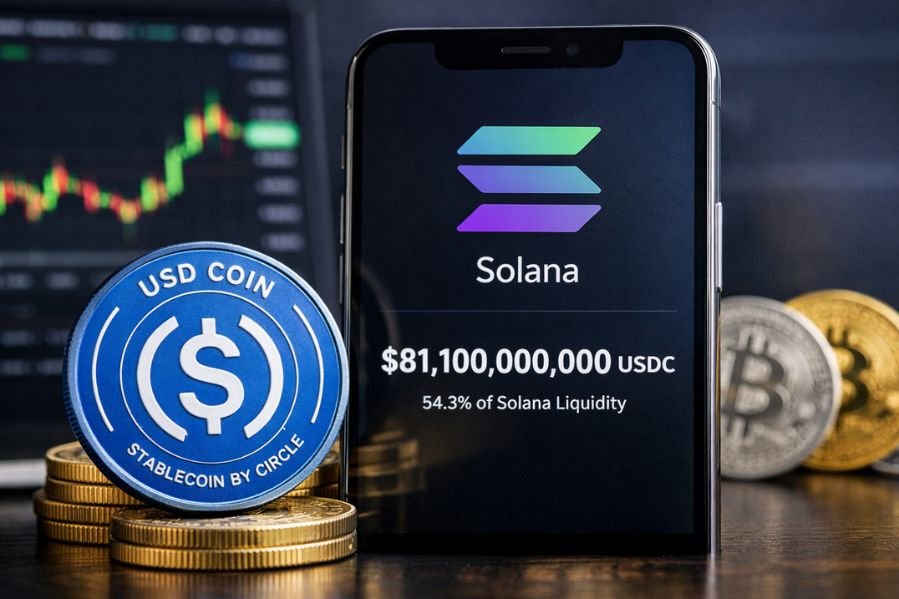

USDC on Solana brings together two powerful ideas in crypto: a dollar-backed stablecoin and a fast, low-cost blockchain. Circle issues USDC natively on Solana, so users do not need to rely on a wrapped or unofficial version of the token. That matters because Circle says native USDC Solana is redeemable 1:1 for U.S. dollars. In contrast, bridged versions do not provide the same level of support.
That difference helps explain why USDC Solana has become such an important topic. By March 2026, USDC had grown into the leading stablecoin on the Solana network. DefiLlama’s Solana stablecoin data shows that USDC accounts for 53.81% of the chain’s stablecoin liquidity. In other words, more than half of Solana’s stablecoin market now sits in USDC.
Solana’s February 2026 ecosystem report said the chain processed over $650 billion in stablecoin transactions in a single month. This shows scale and suggests Solana is a serious settlement network for traders, apps, and payment flows.
This article covers what USDC Solana is, why native issuance matters, and how the token fits the broader Solana economy.
Contents
- Introduction
- Quick Facts About USDC Solana
- What Is USDC on Solana?
- How Native USDC Works
- Why Solana Fits Stablecoin Activity
- Why Native Issuance Matters
- USDC’s Role in DeFi and Payments
- Fees and Transaction Speed
- Institutional Use Cases
- Risks and Common Misunderstandings
- Legacy and Future Outlook
- Conclusion
- FAQs About USDC Solana
- SEO Meta Description
Quick Facts About USDC Solana
| Asset Name | USD Coin (USDC) on Solana |
| Issuer | Circle |
| Token Standard | SPL token |
| Type | Native stablecoin on Solana |
| Official Solana Mint Address | EPjFWdd5AufqSSqeM2qN1xzybapC8G4wEGGkZwyTDt1v |
| Redeemability | Circle says native USDC is redeemable 1:1 for USD |
| Support Status | Circle supports native USDC, not bridged versions |
| Share of Solana Stablecoins | About 53.81% as of March 2026 |
| Stablecoin Volume on Solana | More than $650 billion in February 2026 |
| Fee Structure | Solana charges a base fee of 5,000 lamports per signature |
What Is USDC on Solana?
USDC on Solana is a Circle-issued USD Coin that runs on the Solana blockchain. It uses the SPL token standard, Solana’s standard token format. Users can store it in Solana wallets, send it across the network, and use it in Solana-based apps.
The key point is that this version is native. Circle itself issues it on Solana. As a result, Circle supports it through its infrastructure and redemption framework. That gives native USDC a stronger trust profile than a bridged version that depends on another system.
For anyone researching USDC Solana, the first fact to verify is always the official mint address. Circle lists it as EPjFWdd5AufqSSqeM2qN1xzybapC8G4wEGGkZwyTDt1v. That address helps users confirm that they hold the real native asset rather than a lookalike token.
How Native USDC Works
Native USDC on Solana works like digital dollars on a fast public blockchain. A user can receive USDC in a wallet, send it to another address, trade it on a decentralised exchange, or use it inside DeFi protocols. On the surface, that feels simple. However, the system rests on several layers: Circle’s issuance model, reserve backing, Solana’s token system, and the apps that support the asset.
Circle says it publishes weekly reserve disclosures and monthly third-party assurance reports. It also says that reserve assets exceed the amount of USDC in circulation and that these reserves remain separate from the company’s operating funds. Those details matter because stablecoins depend on trust as much as speed.
So, when people talk about USDC Solana, they are really discussing both a blockchain token and a financial product. The token moves on-chain in seconds. Meanwhile, the issuer’s reserve system supports the dollar peg off-chain.
Why Solana Fits Stablecoin Activity
Solana attracts attention for low fees and high throughput. These traits make it fit for stablecoins. Traders want fast settlement. Apps want cheap transactions. Payment systems want networks to move value quickly and at low cost.
That is where Solana stands out. Its design enables frequent transfers and high transaction volume at costs that remain low compared with many other chains. Because of that, stablecoins fit especially well on Solana. Small transfers remain practical. Large volumes can also move efficiently.
This helps explain the rise of USDC Solana in everyday network activity. As more users, protocols, and payment flows need a dollar unit on Solana, USDC becomes a natural choice. It provides users with price stability while still allowing them to benefit from Solana’s speed.
Why Native Issuance Matters
Native issuance is one of the most important parts of this story. Many users assume all USDC-like tokens are the same. They are not. Circle clearly separates native USDC from bridged versions. A bridge is a system that allows tokens to move from one blockchain to another by locking the asset on the original chain and creating an equivalent version on the destination chain. Circle warns users not to send bridged USDC on Solana to Circle Mint accounts because Circle does not support those assets in the same way.
That difference affects both trust and usability. Native USDC gives users a clearer path to redemption and support. By contrast, bridged assets introduce an additional layer of risk because they depend on the bridge’s design and security assumptions.
As a result, native issuance matters for more than branding. It affects how exchanges list the token, how institutions evaluate it, and how users think about safety. In practical terms, this is one reason USDC Solana has gained such a strong position on the network.
USDC’s Role in DeFi and Payments
USDC has become central to Solana’s on-chain economy. DefiLlama’s March 2026 data shows that USDC holds about 53.81% of the chain’s stablecoin market. That is not a small edge. It means USDC now serves as the primary stablecoin for a large share of activity on Solana.
That role stretches across multiple areas. Traders use USDC as a quote asset. Liquidity providers pair it with other tokens. Lending protocols accept it as collateral or a supply. Treasury managers also use it to move dollar-like value without leaving the chain.
In payment settings, the appeal is different but just as clear. Businesses and infrastructure providers want predictable value, quick movement, and low fees. USDC offers a stable unit. Solana offers speed. Together, they create a useful combination for settlement and transfers.
Fees and Transaction Speed
Low fees are one of Solana’s strongest selling points. Solana’s documentation says the network charges a base fee of 5,000 lamports per signature. Users may also pay a priority fee to receive faster inclusion during busy periods. (solana.com)
Even so, Solana transactions remain cheap in real dollars. That makes frequent stablecoin movement far more practical than on higher-cost networks. Users can rebalance positions, pay counterparties, or move funds between apps without worrying that fees will eat into the value of the transfer.
This is another reason USDC Solana keeps showing up in payment and trading discussions. A dollar-backed asset becomes much more useful when moving it costs very little.
Institutional Use Cases
The institutional story around USDC on Solana has grown stronger. Visa announced that initial banking participants, including Cross River Bank and Lead Bank, had begun settling with Visa in USDC over the Solana blockchain. Visa also said broader U.S. rollout would continue through 2026.
That announcement matters because it shows a real payment infrastructure using the chain for settlement. It does not mean every card purchase suddenly happens on Solana. Instead, it shows that major financial players see value in using stablecoins for back-end fund transfers.
Circle has highlighted earlier work with Visa and merchant acquirers like Worldpay and Nuvei using USDC on Solana. The institutional case is not just future potential; it already exists in real payment rails.
Risks and Common Misunderstandings
No stablecoin is free of risk. USDC may aim to maintain a dollar peg, but users still face issuer, regulatory, and platform risks. Circle’s transparency reports address part of that concern. Even so, trust in a stablecoin always depends on more than one promise. It depends on reserves, disclosures, counterparties, and infrastructure working together.
Users often confuse native USDC with bridged versions. This can cause issues, especially when moving assets between chains or sending them to services that only support Circle-issued USDC. Always check the correct Solana mint address.
Some people also assume that high volume alone proves safety. It does not. High usage shows adoption, not perfection. Still, volume does matter because it reveals where the market places trust and liquidity. On that point, USDC Solana has clearly become a leading stablecoin pair within the Solana ecosystem.
Legacy and Future Outlook
By March 2026, USDC was more than another Solana token. It was part of the network’s core financial infrastructure. DefiLlama’s data shows its dominance. Solana’s reports show stablecoin scale. Visa’s rollout connects on-chain assets to traditional payments.
Still, crypto leadership can change quickly. Competing stablecoins remain. Regulation evolves. Networks compete for capital and developers. Still, current public data shows USDC’s strong position on Solana.
If that trend holds, USDC Solana may remain one of the clearest examples of how stablecoins can function as real settlement tools rather than just trading chips.
Conclusion
USDC on Solana matters because it combines trusted stablecoin branding with a fast, low-cost network. Circle issues native USDC on Solana, offering more clarity than a bridged version. Solana’s speed and low fees make stablecoin use practical at scale.
The numbers support that story. USDC now holds the largest share of Solana’s stablecoin market, while Solana itself processes enormous stablecoin volume. Add institutional settlement activity from Visa, and the picture becomes even clearer: USDC on Solana is no longer a niche product. It is a major part of how value moves across the network.
FAQs About USDC Solana
1. What is USDC on Solana?
USDC on Solana is a Circle-issued native USD Coin that uses the SPL token standard.
2. Is USDC on Solana native or bridged?
Circle supports native USDC on Solana and treats bridged versions differently.
3. What is the official mint address for USDC on Solana?
The official Solana mint address is EPjFWdd5AufqSSqeM2qN1xzybapC8G4wEGGkZwyTDt1v.
4. Why do people search for USDC Solana?
Most users want to verify the native token, understand the mint address, and compare it with bridged alternatives.
5. How big is USDC on Solana?
As of March 2026, USDC accounted for about 53.81% of Solana’s stablecoin liquidity.
6. Why is USDC popular on Solana?
It combines Circle’s support model with Solana’s fast and low-cost transaction environment.
7. How much stablecoin volume has Solana processed recently?
Solana reported more than $650 billion in stablecoin transactions during February 2026.
8. Is USDC on Solana used in institutional payments?
Yes. Visa said banking participants began settling with Visa in USDC over Solana.
SEO Meta Description
USDC on Solana explained: learn how native USDC works, its official mint address, low fees, market share, and growing payment use cases.
